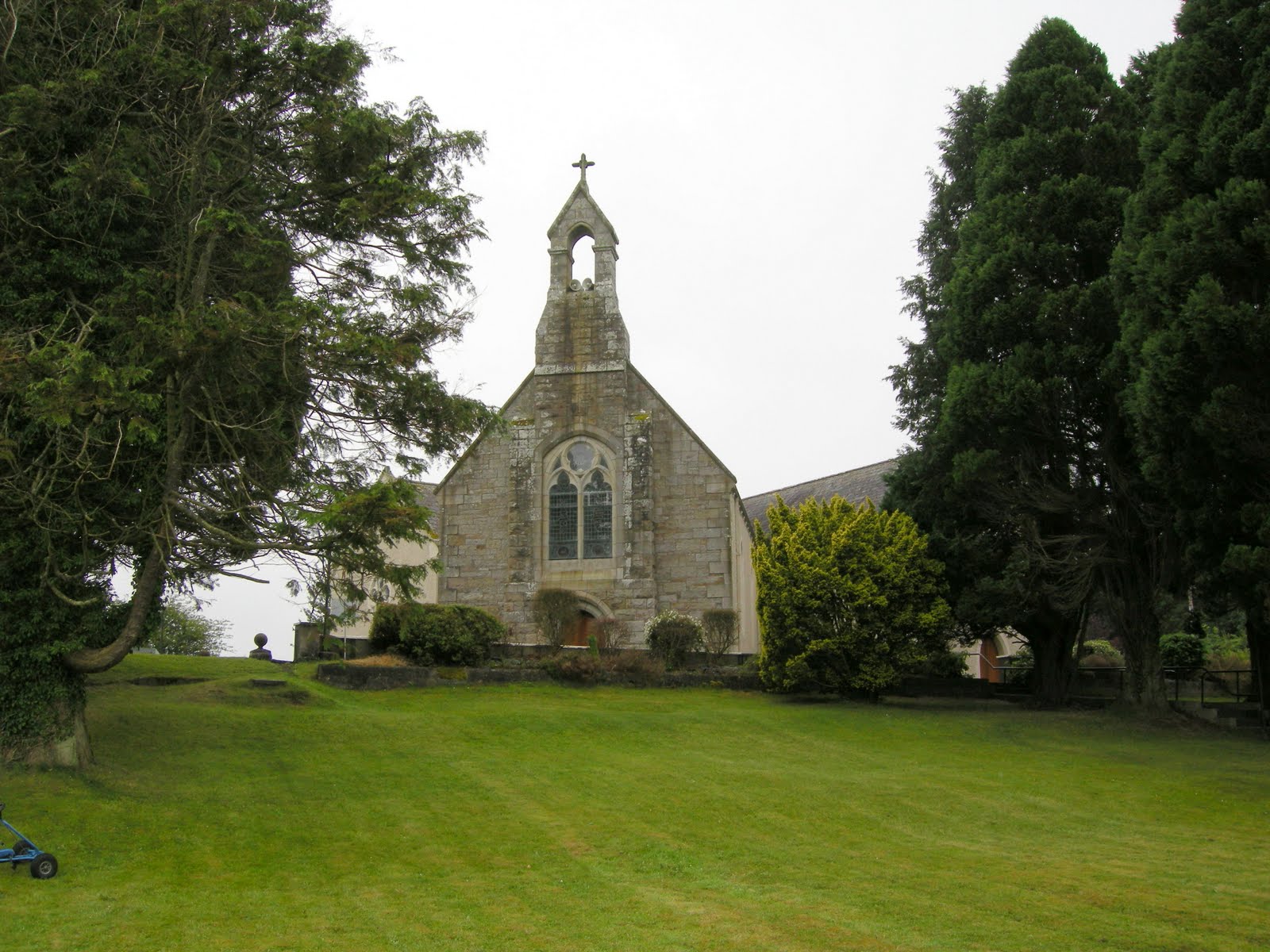
McIntyre Farm, Lislea

McIntyre Farm, Lislea
Farm vacant in 1998

About Lawrence McIntyre and Mary Ginty

About Lawrence McIntyre and Mary Ginty

Lawrence McIntyre was baptized (and possibly born) on August 12, 1854 in Lislea, Kilmacteige Parish, County Sligo, Ireland. His parents are listed as Michael McIntyre and Mary McIntyre on his baptismal record. No other information about his parents is known with the exception of a probable cousin, Patrick McIntyre, who came to the U.S in 1863.

Lawrence's wife, Mary Ginty, was born September 3, 1850 in Carrowbeg, Killasser, County Mayo, Ireland. Her parents are John Ginty and Margaret Convey(Conway). In addition to their daughter Mary, they had three other children: Margaret (Bridget), Catherine and Patrick.

Lawrence and Mary were married in Killasser on March 1, 1877 and resided in Lislea where they raised their family. They had six known children, all born in Ireland. Thomas Joseph (1878-1939); Catherine (1879-c1915); Mary (1881-1927); Bridget (1881-c1945); Lawrence J. (1890-1943); and John (c1892-?). Lawrence and Mary died in Ireland in the early 1930s.

The descendents of Patrick McIntyre (c1831-1901), mentioned above, and his wife Bridget Stevens (c1833-1908) are also represented on this McIntyre-Ginty Blog. Patrick's farm in Lislea, County Sligo, was to the right of the house in the photo at the top of this page. A separate blog has also been created for Patrick and Bridget and may be viewed at www.mcintyrestevens.blogspot.com

Saturday, August 30, 2014

Lislea, County Sligo, in 1825

The Tithe Applotment Books record the results of a unique land survey taken to determine the amount of tax payable by landholders to the Church of Ireland. This data set represents a virtual census for pre-Famine Ireland. 

The image below is from a microfilm of the original hand written book viewed at the Montreal Public Library in 1998. The front page from the section for Kilmacteige Parish is dated November 1, 1825. Note there are three McIntyres on the list for Leslea (Lislea). 
  • Patrick McEntire occupied 14 Irish acres and the land was taxed at 14 shillings
  • James McIntire occupied 1 Irish acre, 2 perches and the land was taxed at 1 shilling, 6 pence
  • John McEntire occupied 11 Irish acres, 3 rods and the land was taxed at 11 shillings
The note to the right of all the land in Lislea reads:

"Eleven Pounds seven shillings and nine pence the sum applotted on two hundred and eight acres and three perches in the Townland of Lislea as annexed."

From this document, it appears there were 26 heads of household/land occupiers living in Lislea in 1825. They are listed on lines 302 - 327 below. If you double click on the image it will enlarge.

Michael McIntyre (c1805-1891) would have been approximately 20 years old in 1825 and not very likely to be the occupier of a parcel of land. Could one of these individuals, Patrick, James or John, be the father of Michael?  


Irish Mile vs Statute Mile
  1. An Irish acre is a unit of area historically used in Ireland, Yorkshire, and regions bordering the Solway Firth. One Irish acre is equal to about .66 hectares (1.6 acres) (196⁄121) acre, 6600 square meters, or 70,560 square feet. Source: Wikipedia, accessed August 30, 2014.
  2. Table of Constants
    1 Statute Mile = 1760 Yards
    1 Irish Mile = 2240 Yards
    11 Irish Miles = 14 Statute Miles
    1 Statute Acre = 4840 SQ. Yards
    1 Irish Acre = 7840 SQ. Yards
    121 Irish Acres = 196 Statute Acres
Source: Ordinance Survey Ireland, http://www.osi.ie/Education/Secondary-Schools/Teacher-Resources/Conversions-(1).aspx, accessed August 30, 2014


British Pound, Shilling vs American Dollar

In 1825, one British pound was equivalent to 93 British pounds in 2013. Source: http://safalra.com/other/historical-uk-inflation-price-conversion/

There were 20 shillings to a pound, so one 1825 shilling would be worth 93/20 or $4.65 today. As an example in the above, Patrick paid 14 shillings or the equivalent of 14x4.65 = $65.10 in taxes for his 14 Irish acres.


Information on the Tithe Applotment

Background
The money so raised was for the upkeep of the Church of Ireland, the established church until 1869. The word tithe comes from the Latin for a tenth part, and refers to the custom of paying a tenth of one's earnings to the church. Originally this offering was in kind, but as money increasingly became the determinant of social and economic dealings, the tithe came to be paid similarly. Following the Composition Act of 1823, which decreed that tithes be paid in money, a valuation survey was carried out of each civil parish in Ireland to determine how much each landholder should pay. Over the next fifteen years this survey listed all landholders in a parish.
Assessing the Tithe
The survey was conducted by those who stood to gain from tithes, namely personnel of the Church of Ireland, usually members of the select vestry or apploters appointed by them 'to regulate and sub-divide'. The applotment enumerated each landholder in a parish, with details such as name of townland, size of holding, land-quality and types of crops. The amount of tithe payable by each landholder was based on all of these factors and calculated by a formula using the average price of wheat and oats from 1816-23. Most parishes had at least one tithe survey during from 1820-38 while some had two. Some parts of the country were exempt from paying tithe, among them glebe lands (land occupied by established clergymen), granges (land which in pre-Reformation times had belonged to a monastery) and all towns.
Opposition to Tithes
All this was eminently logical and scientific except for one rather serious snag; the tithe was to be paid by everyone, not just members of the Church of Ireland. Therefore, it was deeply unpopular with Catholics and Presbyterians who had their own clergy and who resented having to support a rival denomination whose members enjoyed more social and economic privileges than they. Furthermore, Catholics and Presbyterians between them outnumbered the established church, the latter being the preserve of those with social and political power. Not surprisingly there were instances of violent resistance, and numerous outbreaks of agrarian unrest in the 1830s were dubbed the 'tithe war'.
The End of Tithes
Tithes were payable directly to the Protestant minister, but collection was often difficult as people held out against the indignity and the financial burden. It should be remembered that all landholders had to pay tithe, and the majority of these were impoverished tenants already faced with heavy rents payable to their landlord. From 1838 on, the tithe was amalgamated with the land-rent and collected by landlords, who then passed on the church's share. This had the double effect of removing the trouble of collection from ministers and also of making payment more likely, given that non-payment of dues to the landlord could lead to eviction. Resentment against tithes festered as one of the ills associated with Ireland's ramshackle landlord system until the disestablishment of the Church of Ireland in 1869. Thereafter this denomination had to raise its own finance in the manner of other churches.
Exceptions
In total the Tithe Applotment Books comprise some 2,000 hand-written volumes of varying degrees of legibility. Even allowing for the exemption of town-dwellers and landless labourers from the survey, it still constitutes the nearest to a census of pre-Famine Ireland that we have - especially in light of the absence of formal census data from this period. As mentioned above, however, it is not comprehensive and some parts of the country were not surveyed. It should not be assumed that these 'exceptions' from the tithe survey were due to parishes being overlooked since there are usually explanations as to why they were tithe-free. In some cases there are no tithe books because a certain parish did not exist, or was part of another parish, at the time of the survey. There were also some parishes outside parochial jurisdiction, such as the above-mentioned granges, while glebe lands and all towns were also exempt. Details of exceptions are provided below. (1)

Source: The Tithe Applotment Books of Ireland, 1823-1838: www.genealogy.com accessed August 29, 2014.

Note: I have copied this blog to the www.mcintyrestevens.blogspot.com site as either Patrick, James or John should be Edward McIntyre's father as well.

Sunday, May 19, 2013

Patrick McIntyre Inquiry, 1863

Lawrence McIntyre's father was Michael McIntyre.  It is believed one of Michael's nephew or cousin was Patrick McIntyre, the occupier of the property next to Michael's as listed in the Griffith's Valuation c 1858.

Patrick and his family arrived in New York City on April 18, 1863.  The following "Information Wanted" ad appeared in the New York newspaper the Irish-American on November 21, 1863.

"Of Mary McIntyre, a native of the Parish of Kilmactige, County Sligo, who married Hugh McGlauhin, of County Meath, Ireland. Also of her sister Bridget, who married Samuel Smith, an American by birth.  When last hear from, they resided in the State of New York.  Any information of them will be thankfully received by their brother, Patrick McIntyre, who lately arrived, by writing to him in care of Patrick Foy, 81 Baxter Street, New York."

Questions:
  • Could Mary McIntyre McGlauhin and Bridget McIntyre Smith be sisters or cousins of Michael too?
  • Who is Patrick Foy?
  • Who is Hugh McGlauhin?
  • Who is Samuel Smith?
  • Who else lived at 81 Baxter Street, NY
  • Did Patrick ever locate Bridget and Mary?

Source: DeGrazia, Laura Murphy, compiler.  Irish Relative and Friends: From "Information Wanted" Ads in the Irish-American, 1850-1871. Baltimore, Maryland: Genealogy Publishing Co., 2001.  Page 186.

Patrick McIntyre's 1863 Passenger List

On April 18, 1863, Patrick McIntyre (probable nephew of Michael McIntyre) along with his wife Bridget and their five children, Edward, Barty, Mary, Dominick and Cath, arrived in New York Harbor on the SS Orient leaving out of Liverpool, England.


Source: Ancestry.com. New York, Passenger Lists, 1820-1957 [database on-line]. Provo, UT, USA: Ancestry.com Operations, Inc., 2010. Year: 1863; Arrival: New York, New York; Microfilm Serial: M237; Microfilm Roll: 227; Line: 29; List Number: 305. National Archives, Washington, DC. Patrick McIntyre entry, accessed: May 19, 2013.

Friday, February 8, 2013

John Ginty Farmland in Carrowbeg

While in Ireland in July 2011, I visited Carrowbeg, County Mayo and took a 360 degree video of the land in front of the property where John Ginty lived and specifically the house where Sally Ruane Gilger grew up.  In the video I say the open pasture land belonged to John Ginty, I'm not sure that is true.  But, the spot I took the video from is in front of the Ginty/Ruane (now Rowley) house Carrowbeg.

For some still photos of the Ginty/Ruane/Rowley house and property, click here.


Source: Elaine McIntyre Beaudoin, video, July 2011.

Thursday, March 15, 2012

Patrick McIntyre Farm in Lislea, County Sligo

Patrick McIntyre, believed nephew of Michael McIntyre, is listed in the Griffith's Valuation living on a parcel of land which is adjacent to the land that Michael McIntyre lived on and eventually owned.  In an earlier post, it is noted that Patrick McIntyre left the property sometime around 1863.

This video was taken in the summer of 2011 of the property Patrick McIntyre occupied prior to 1863 in Lislea.

Friday, January 6, 2012

McEntire occupiers in Lislea c1858 & 1863

Richard Griffith undertook the Primary Valuation of Ireland in the mid-1800s.  This valuation, which is commonly referred to as Griffith's Valuation, is a unified, country-wide valuation of land and property taken as a result of the Tenement Valuation Act of 1846.  For each county, a "snapshot" was published at a specific point in time between 1848 and 1864, with the date for each county dependent upon the year in which that county was surveyed. (1)

The County Sligo survey was completed on July 7, 1858. (2)  The following is a reproduction of the page which shows the Townland of Lislea, Barony of Leyny, Civil Parish of Kilmacteige, Poor Law Union (Registrar's District (RD)) of Tobercurry, Electoral Division (ED) of Aclare.  Note the occupiers of parcels 7 & 8 are Michael and Patrick McEntire, respectively.

Griffith's Valuation, 1858 -- Click on image to enlarge


Once a tenement's valuation was set, provision was made for an annual revision of the assessment according to Section XXX of the 1846 Act. To carry out the annual revision of a tenement: "... that within Ten Days after the First day of February in each Year after any such Valuation shall be completed and in operation every Collector of Poor Rates within each Poor Law Union ... shall make out and lay before the Board of Guardians ... a list of all the Tenements or Hereditaments* situate within every Townland in the said Union which shall require Revision... ." (3)

The tax collector was expected to include on the list the change of an occupier's name, for example, because of death, migration, emigration, or a change of rate-payer, for example, from father to son or widow to son.  The lessor from whom a holding was rented required a name change when the holding was sold or leased to a new landlord.  When part of a farm was consolidated with another farm, the collector was expected to inform the Board of Guardians; similarly, when a farm was divided, he recorded a need for change on the list. (4)

Below, the Valuation Revision List (5) for Lislea for the years 1859-1863 shows the name Michael McEntire (father of Lawrence McIntyre) with reference #7 and Patrick McEntire with reference #8.  These Revision Lists were later called Cancellation Books, as they were "cancelled" once the next valuation book was started.

The references 7 & 8 as listed in the Valuation Revision list are the same two pieces of property listed in the above original 1858 printed Griffith's Valuation.

Note on the following Valuation Revision sheet Patrick McEntire's entry has a red line through it.  At the end of the line it reads "Fee down, 63."  The 63 refers to 1863 the year the line was drawn through the entry, i.e., Patrick was no longer the occupier.  "Fee down" appears to mean the parcel of land in question does not have an individual who is entitled to inherit the lease. The leases at this time were often written to include "three lives" and were therefore good until the youngest of the three named men gave up the lease and/or died.  

Click on image to enlarge
The fact that Patrick's name is struck on this Valuation Sheet, further supports additional information we have that Patrick and his family emigrated from Ireland to the US in 1863.

The immediate lessor at this time was William Ormsby Gore. In the next Revision list it shows that Arthur O'Hara, Michael O'Hara, Denis O'Hara and John Farrell were the occupiers of parcel #8 and were leasing from William Orsmby Gore.  Note that these four individuals are also noted in parcels 5 & 6 in the above Valuation Revision List as well as Griffith's Valuation of 1858.

The question that remains, were Michael McEntire and Patrick McEntire brothers or cousins?

*Any property that can be inherited.

Sources:
(1) Elizabeth Kelley Kerstens, "Tracking Irish generations in land valuation records," NGS News Magazine, July/August/September, 2005, pg. 55.
(2) James R. Reilly, Richard Griffith and His Valuation of Ireland, Baltimore: Clearfield, 2000, Appendix No. 8, page 78.
(3) Ibid., pg. 43.
(4) Ibid., pg. 43.
(5) Valuation List no. 3, County Sligo, ED Aclare, RD Tobercurry, page 37, 1859-1863, Valuation Office, Dublin, Ireland, viewed and copied July 18, 2011.

Thursday, January 5, 2012

Bridget McIntyre, Birth Registration 1881

Bridget McIntyre, daughter of Larry McIntyre and Mary Ginty, was born on August 1, 1881.  She was the twin sister of Mary McIntyre.  She was born in Lislea on the family farm.


Source: Ireland, Civil Registration Office

Monday, January 2, 2012

Bridget McIntyre - Patrick Haran Marriage Registration

Bridget McIntyre, daughter of Lawrence McIntyre and Mary Ginty, married Patrick Haran of Kincullew, son of James Haran.  Patrick was a laborer and his father was a farmer when Patrick and Bridget married on September 3, 1911.  Neither had been married previously.  They were married in the chapel at Toulestrane (St. Attracta Church) in the registration district of Aclare, union of Tubbercurry, County Sligo.  Bridget would have been about 30 years old when she married.

They were married by Fr. John O'Dowd.  Witnesses were John McIntyre (believed to be the brother of Bridget) and Kate Walsh.


Source: Ireland, Civil Registration Office

Mary McIntyre - Birth Registration

Mary McIntyre (Egan) was born on August 1, 1881 in Lislea, County Sligo.  Her parents are noted on the birth registration below as Larry McIntyre and Mary McIntyre, nee Ginty.  Mary Ginty McIntyre registered the birth on the 6th of September 1881 in the district of Aclare, union of Tobercurry, County Sligo.


I was able to get a copy of the birth registration when I was in Dublin in July, 2011.

Source: Ireland, Civil Registration Office

Monday, November 7, 2011

Ginty Farm, 2011

Photos of the land in Carrowbeg that John Ginty, Mary Ginty McIntyre's father, occupied in the 1850s and later owned.  The house is now owned by the Rowley family and they are unrelated to the Gintys.  In the 1850s there were 13 families living on the parcel of land.

The road in front of the Ginty farm

Driveway to the house where Sally Ruane Gilger lived, great-granddaughter of John Ginty

James Gilger, Sally's son, standing in front of the same property in 2001.


(Ginty)/Ruane/Rowley home in 2011


Fields across the road from the Ginty homesite

Photos: Elaine Beaudoin, August, 2011; Photo of James Gilger courtesy of Sally Gilger.

Killasser Church

Mary Ginty was baptized on September 3, 1850 and married Lawrence McIntyre on March 1, 1877 both in this Killasser Church.

Killasser Church, County Mayo

For more information go to additional postings in this blog:

Killasser Civil Parish

Killasser Catholic Church

Mary Ginty Baptismal Record 

Mary Ginty and Lawrence McIntyre Wedding Record


Photos: Elaine Beaudoin, July, 2011

Thursday, September 1, 2011

Michael McIntyre, Died 1891

Michael McIntyre's death record shows Michael, father of Lawrence McIntyre, died on November 9, 1891 in Lislea.  It also states there was no medical attendant.  It is assumed he died on his farm in Lislea.  At the time of his death he was a widower, so Mary, his wife, must have died prior to November, 1891.  Given his age is listed at 86 years, his birth year would be around 1805.  The registration which was done in the Registrar's District of Aclare; Superintendent Registrar's District of Tobercurry, notes that a Thomas McIntyre was present at death and he is also from Lislea.  Thomas McIntyre (1878-1939) would have only been about 13 years old at the time of Michael's, his grandfather's, death.  It seems strange that a 13 year old would report the death.  At first I thought it could be another son of Michael's named Thomas or even a brother named Thomas, but neither of them, if they existed, would have been living in Lislea.  Curious.

To enlarge, double click on image

Document provided by the Registration Office, Dublin, Ireland, July, 2011.  Volume 4, Page 345, Entry, 73, 1892.

Saturday, July 9, 2011

1911 Irish Census - McIntyre/Ginty

The 1911 Census of Ireland lists Laurence McIntyre and his wife Mary (Ginty) with two of their children Bridget, age 25, and John, age 19.  It notes that all but Mary were born in County Sligo, she was born in County Mayo.  At the time of the census, they were living on the farm in Lislea, Kilmacteige Civil Parish, County Sligo.


The census states Laurence and Mary have been married 34 years.  I have their marriage record from Killasser Parish, County Mayo with the date of March 1, 1877 which agrees with the information provided.  In addition, it states Mary had six children with five currently living.  Their daughter Catherine died young.  Although I don't have a death record for Catherine, all the rest of the children lived beyond 1911, so it must be Catherine who is deceased in 1911.

Laurence could not write and did not sign the census, but his son John was the witness to his "mark."  My belief is that it is John McIntyre's signature at the bottom of the census.

On associated 1911 Census sheets -- Form B. 1 - House and Building Return and Form B. 2 - Return of Out-Offices and Farm-Steadings -- it notes the McIntyres had three out-buildings including a stable, a cow house and a piggery.  The house itself had either a wood or thatched roof, was composed of only two rooms and had two windows in the front of the home.   Certainly a modest home in which to raise six children.

Daughter, Bridget, married P. Billy Haran and lived on the farm raising five daughters:  Mary (Crane), Annie (Brennan), Tessie (Cafferty), Bridget (Heffernan) and Josephine (O'Malley/Pointing).  Their daughter, Tessie, married Dominic Cafferty and they then lived on the farm.  Dominic died in the early 1980s.  They had no children.  In the 1990s, Tessie sold the farm to a neighbor and moved to live with her niece, daughter of Bridget (Heffernan), in Cheekpoint, County Waterford.  I am told she eventually went to England, probably to be near her sisters, where she died in 2004.

So, after more than 150 years, no longer were there any descendants of Michael McIntyre (c1830-a1854) living on the farm.

Killasser Civil Parish, Barony of Gallen, County Mayo, 1837

Mary Ginty was from Killaser Civil Parish.

Killaser, a parish, in the barony of Gallen, in county Mayo, and province of Connaught, 6 miles (E. N. E.) from Foxford, on the River Moy and the road to Swinford; containing 6,581 inhabitants.  This parish was the scene of a sanguinary battle between the native septs of the Jordans and the Rowans, at a spot since called Lugnafulla, or "the valley of blood". It comprises 10,000 statue acres, of which about 6, 000 are arable and the remainder principally bog and mountain; the land is of indifferent quality and is in many places covered with rocks of great size; some of the eastern portion is more productive, but agriculture is in a very backward state; there is a large tract of irreclaimable bog.  It is a vicarage, in the diocese of Achonry, forming part of the union of Templemore; the rectory is impropriate in the representatives of the late Roger Palmer, Esq.  The titles amount to L512.0.4., which is equally divided between the impropriator and the vicar, there are two chapels, situated respectively at Calla and Boulebee, both well built and roofed with slate.  About 90 children are taught in a public school; and there are five private schools, in which are about 450 children.  There are several Danish forts in the western portion of the parish; at Calla is a small lake, in which is an island presenting appearances of fortifications, said to have been inhabited by the sept of the Rowans; at Erbull and are the ruins of an Old Castle; and there are ancient burial places at Killasser, Blackpatch and Calla.

Extracted from A Topographical Dictionary of Mayo, Samuel Lewis, 1837.

Friday, February 18, 2011

Madden - Ginty Marriage Record, 1867

Thomas Madden and Catherine Ginty (Genty), the sister of Mary Ginty McIntyre, were married on February 2, 1867 by Fr. John Finn in the Roman Catholic parish of Killasser.  They were both single at the time and of full age, i.e., 21 or over.  The register notes that Thomas Madden is a landholder and his residence at the time of marriage was Lahardane, which is also in the Civil Parish of Killasser.  Catherine's residence at the time of marriage is noted as Carrabeg, Killasser Parish, County Mayo.  Thomas' father was also named Thomas and Catherine's father was named John. Both fathers are listed as landholders.

Witnesses to their marriage were Michael O'Donnell and Mary Durcan.

Irish Civil Records, Page 673, line 17, February 2, 1867, Roman Catholic Chapel of Killasser, Registrar's District of Foxford, Union of Swinford, County Mayo

Thursday, February 17, 2011

1901 Irish Census - McIntyre-Ginty

In 1901, living with Lawrence and Mary (Ginty) McIntyre were four of their children: Bridget, 19 years old, Mary also listed as 19 years old (she would come to US and marry Daniel Egan); Lawrence, 10 years old (would come to US and marry Lillian O'Brien) and John eight years old.  Their son Thomas (who would come to the US and marry Ellen Walsh) was in England working in a coal mine at the time of the 1901 Irish Census.  There was also a daughter, Kate, who would be about 22 in 1901 and might have been married or have previously died.


On the census, it records Lawrence as a farmer born in County Sligo and his wife Mary (Ginty) as born in County Mayo.  Lawrence could not write, note his "X" on the signature line.  James Rogan witnessed the "X" as the enumerator.  It is interesting, even though Lawrence could not read and write, Mary, his wife can.

On another page of the Census, it provides information on the "House and Building Return."  When it describes the McIntyre house it states: a private dwelling, walls of stone, brick or concrete and a roof of wood or thatch.  It had two rooms and two windows.

In 1901, per the census summary for Lislea, there were 11 houses all inhabited and a school.  A total of 20 males and 20 females.  Of the 40 individuals in Lislea, 35 were Roman Catholic and five were Church of Ireland.

The names of the other heads of household in Lislea in 1901 were: John O'Hara, Michael Donegan, Patrick Kildunne, Maria Kildunne, Patrick Walsh, Denis O'Hara, Denis Murtagh, Michael Murtagh, Margery Armstrong and Mary Connolly.  A William Evans was the landholder for the property occupied by Denis O'Hara and Mary Connolly.  All the rest owned their own land, including Lawrence McIntyre.

Sunday, December 12, 2010

Mary Ginty McIntyre's Sibling - Patrick

It is believed that John Ginty and Margaret (Peggy) Conway had a fourth child and a son.
Patrick Ginty

On the 1901 Irish Census for the Townland of Carrowbeg, Parish of Killasser in the entry for Edward and Bridget O'Donnell, in addition to their daughter Bridget, is listed a Patrick Ginty.  He is noted as Brother-in-Law. This would make him Bridget (Margaret) Ginty O'Donnell's brother.  It states he cannot read and his age is 40, giving him a birth year of approximately 1861.   It states that he is a farmer's son, not married and born in County Mayo. Further, it is noted that he is an Idiot. The form is signed by Edward O'Donnell.

County Mayo, Swinford, Cuildoo, Carrowbeg Townland, Parish Killasser


In the 1911 Irish Census for the Townland of Carrowbeg, Parish of Killasser in the entry for Edward and Bridget O'Donnell, again their daughter Bridget is listed along with the brother-in-law, Patrick Ginty.  However, this time his age is given as 69 giving him a birth year circa 1842.  This year is probably closer to an actual year.

It is noted in the report from the Mayo North Family History Centre report that the earliest records for Killasser are for the year 1847.  This most likely accounts for no baptismal record for Patrick Ginty.  He is believed to be the oldest of the children of John Ginty and Margaret Conway.

It is interesting that when Thomas J. McIntyre, CM was collecting genealogical information, no mention of the existence of Patrick Ginty was made.

In 2011, at a luncheon with Sally Ruane Gilger, I asked if she knew anything about a Patrick Ginty.  She said she thought he might have been a change-of-life baby for Bridget Ginty O'Donnell (her grandmother) and he possibly had Down's Syndrome.  So, perhaps the age given in the 1901 Irish Census was more accurate and he was born c1861, i.e., the last of the O'Donnell/Ginty children.  But, if so, there should be a baptismal record for him.

Saturday, October 23, 2010

Mary Ginty McIntyre's Sibling - Margaret

The third child of John Ginty and Margaret (Peggy) Convey:

Margaret (Bridget) Ginty O'Donnell

Margaret was baptised in the Roman Catholic Parish of Killasser on the 20th of March 1853.  Sponsors were James Ginty and Mary Cahill.  Margaret was known for most of her life as Bridget.

Margaret "Bridget" married Edward O'Donnell, c 1892.  They had at least one child: Bridget "Bea" O'Donnell born c 1897.  The child Bridget "Bea" married James Ruane.   

Margaret died c 1931 and her husband, Edward O'Donnell, died c 1946.

Sources: Mayo North Family Heritage Centre, December 8, 1998 and Family Tree produced by Thomas J. McIntyre, CM, c 1990.


Friday, September 3, 2010

Mary Ginty McIntyre's Sibling - Catherine

John Ginty and Margaret (Peggy) Convey had four known children.  The oldest child was:

Catherine Ginty Madden

Catherine was born circa 1849 as per 1901 Irish Census of Population Returns.  Catherine married Thomas Madden, son of Thomas Madden from Lahardane in Killasser. They were married in Killasser Roman Catholic church on the 2nd of February 1867.  The ceremony was performed by Reverend John Finn and witnessed by Michael O'Donnell and Mary Durkin.  In the 1901 Irish Census, Catherine Madden (nee Ginty) is recorded as being a widow aged 52 years.

A Thomas Madden, a 55-year old married man was found dead in Crohan Lake on Monday morning the 1st of August 1898.  His death was registered by Edmond C. Kelly, coroner for Co. Mayo.  It is believed that this is the husband of Catherine.

Thomas and Catherine had eight known children:
1.  Mary, baptized on the 4th of December 1867.   Sponsors were Pat Madden and Mary Ginty
2.  Bridget, baptized on the 2nd of January 1869.  Sponsors were Thomas Ginty and Mary Kennedy.
3.  Michael, baptized on the 11th of August 1870.  Sponsors were James Madden and Mary Ginty.
4.  John, baptized on the 24th of September 1870.  Sponsors were John Ginty and Mary Kennedy.
5.  Thomas, baptized on the 24th of September 1871.  Sponsors were Michael and Mary Ginty.
6.  Pat, baptized on the 15th of January 1876.  Sponsors were Richard Madden and Mary Ginty.
7.  James, baptized on the 19th of November 1879.  Sponsors were unknown and Kate Sheeran.  James died on the 11th of December 1879 aged 1 month from convulsions.  His father Thomas registered the death.
8.  James, baptized on the 2nd of December 1880.  Sponsors were Michael Madden and Bridget Ginty.

Source: All information compiled by the Mayo North Family History Centre, December 7, 1998.

Friday, July 16, 2010

Daughters of Bridget McIntyre and P. Billy Haran


Bridget McIntyre and Billy Haran had five daughters, all born in Ireland. This photo was taken c1970s and was part of Thomas J. McIntyre, CM's collection. Pictured above from left to right are: Annie Haran Brennen (1913-2004), Mary "May" Haran Crane (1912-2005), Bridget "Bridie" Haran Heffernan (1915-1993), Josephine "Josie" Haran O'Malley Pointing (1917-2004), and Tessie Haran Cafferty (1914-2004).

I had the opportunity to meet Tessie and Bridie at the Haran (McIntyre) Farm in Lislea, when I visited Ireland in the early 1980s and to meet the rest of the sisters when I was in London in 1997. They were all lovely ladies.
Posted by Picasa